How LLM Training Works: From Examples to Better Predictions
What LLM training really means
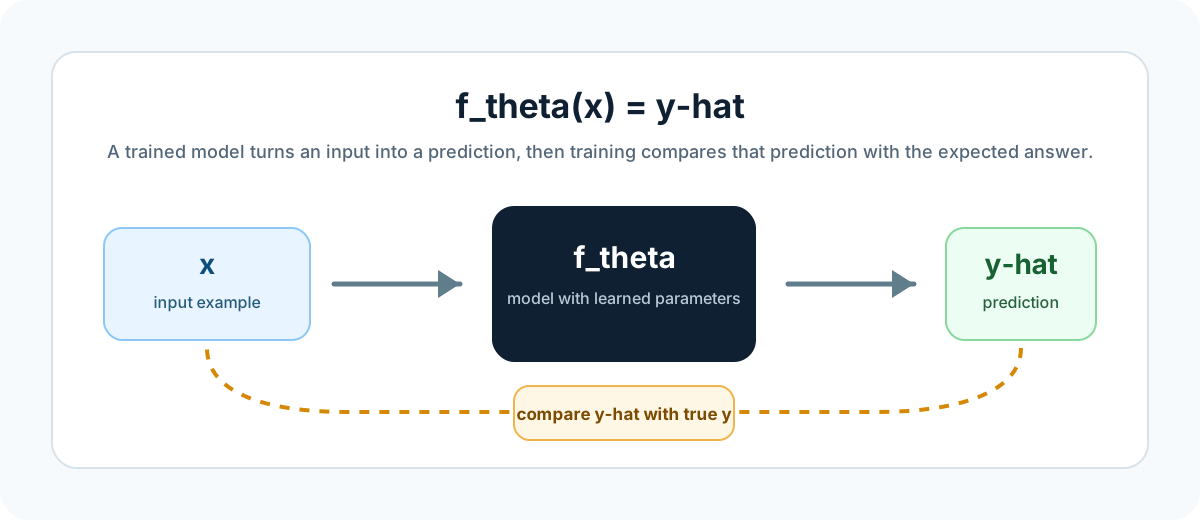
Training a large language model is the process of teaching a model to make better predictions. At a high level, the model sees an input, produces an output, compares that output against the expected answer, and then adjusts itself to reduce future mistakes.
The formula you may have been reaching for is better written as:
f_theta(x) = y-hat
That is the ASCII-safe version. In mathematical notation it is f_θ(x) = ŷ, which renders as f_theta with the Greek theta parameter and y-hat as the prediction. In plain English, a parameterized model maps an input x to a prediction y-hat. The symbol theta represents the model parameters: the internal values that change during training.
Prediction is not the same as truth
In machine learning notation, y usually represents the true label, expected answer, or ground truth. The prediction is written as y-hat, meaning the model's estimate of y. The distinction matters because a model can produce a confident prediction that is still wrong.
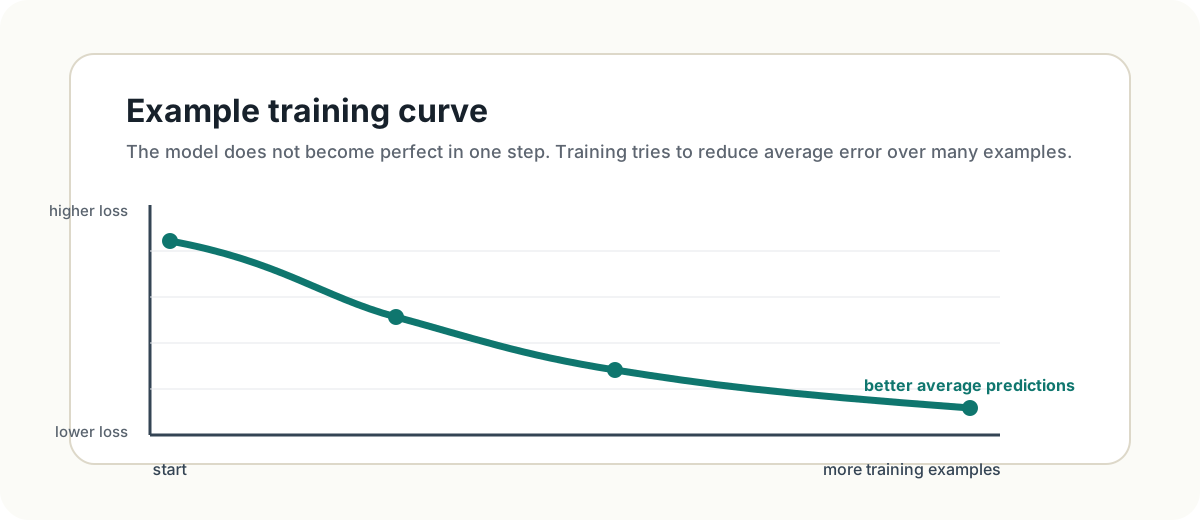
During training, the system compares y-hat with y. A loss function measures the error, and an optimizer updates the model parameters so the next prediction is a little more likely to be useful. Repeating that loop across many examples is how the model learns statistical patterns.
A simple example: train a tiny spam classifier
Imagine a small support inbox classifier. We want the model to read a message and predict whether it is likely spam. The input x is the message. The true label y is the human-approved answer: 1 for spam and 0 for not spam. The prediction y-hat is the model's estimate before it sees the correct label.
| Training example | Input signal x |
True label y |
Model prediction y-hat |
What training learns |
|---|---|---|---|---|
| 1 | “Win a free prize now” | 1 spam | 0.72 spam | Prize language is a strong spam signal. |
| 2 | “Your invoice is attached” | 0 not spam | 0.41 spam | Business terms alone should not trigger spam. |
| 3 | “Urgent account verification required” | 1 spam | 0.63 spam | Urgency plus account language can raise risk. |
On each row, the model predicts a score, compares it with the true label, and updates its parameters. A real LLM is much larger and trains on richer language tasks, but the learning loop is the same: predict, compare, measure error, update, repeat.
The training loop as a chart
| Step | What happens | Example in the spam classifier |
|---|---|---|
| 1. Input | The model receives x. |
A message arrives. |
| 2. Prediction | The model computes y-hat. |
Spam probability is 0.72. |
| 3. Loss | The system compares y-hat with y. |
Correct label is spam, so this prediction is close but not perfect. |
| 4. Update | The optimizer adjusts theta. |
Weights for useful signals move slightly. |
| 5. Repeat | The process runs over many examples. | The classifier becomes more reliable on average. |
What changes during training
The model architecture defines the general structure of the system, but the parameters define what the model has learned. For large language models, there can be billions of parameters, each contributing in a small way to how the model interprets text and generates responses.
The training loop usually follows this pattern:
- The model receives an input example.
- It generates a prediction.
- The prediction is compared with the expected output.
- A loss function measures the error.
- The model parameters are updated to reduce that error.
- The process repeats across many examples.
Why this matters for AI governance
For businesses using LLMs, the distinction between prediction and truth is more than a technical detail. A model output can sound polished while still being unsupported, outdated, or outside the organization's policy boundary. The model is producing a prediction based on learned patterns, context, and instructions; it is not automatically retrieving truth.
That is why production AI systems need evaluation, monitoring, access control, cost controls, and policy enforcement. Tools such as AI Token Guard help teams think about model usage as an operational system: what data is sent, which providers are used, what risks are visible, and how the organization keeps control as usage grows.
Training is not the same as deployment
Training creates or improves the model. Deployment puts that model into a product, workflow, or business process. Once deployed, the model may still make incorrect predictions, encounter unfamiliar inputs, or behave differently as usage patterns change.
Good AI operations do not stop at model training. They include prompt management, retrieval design, security review, human approval gates, usage monitoring, and continuous evaluation. These practices help teams move from experimentation to reliable business use.
The core idea
The corrected notation f_theta(x) = y-hat captures the heart of machine learning: a model with learned parameters takes an input and produces a prediction. Training improves those parameters by comparing predictions against expected answers.
For business and engineering teams, the practical takeaway is simple: LLMs are powerful prediction systems, not automatic sources of truth. Their value depends on how well they are trained, evaluated, governed, and integrated into real workflows.